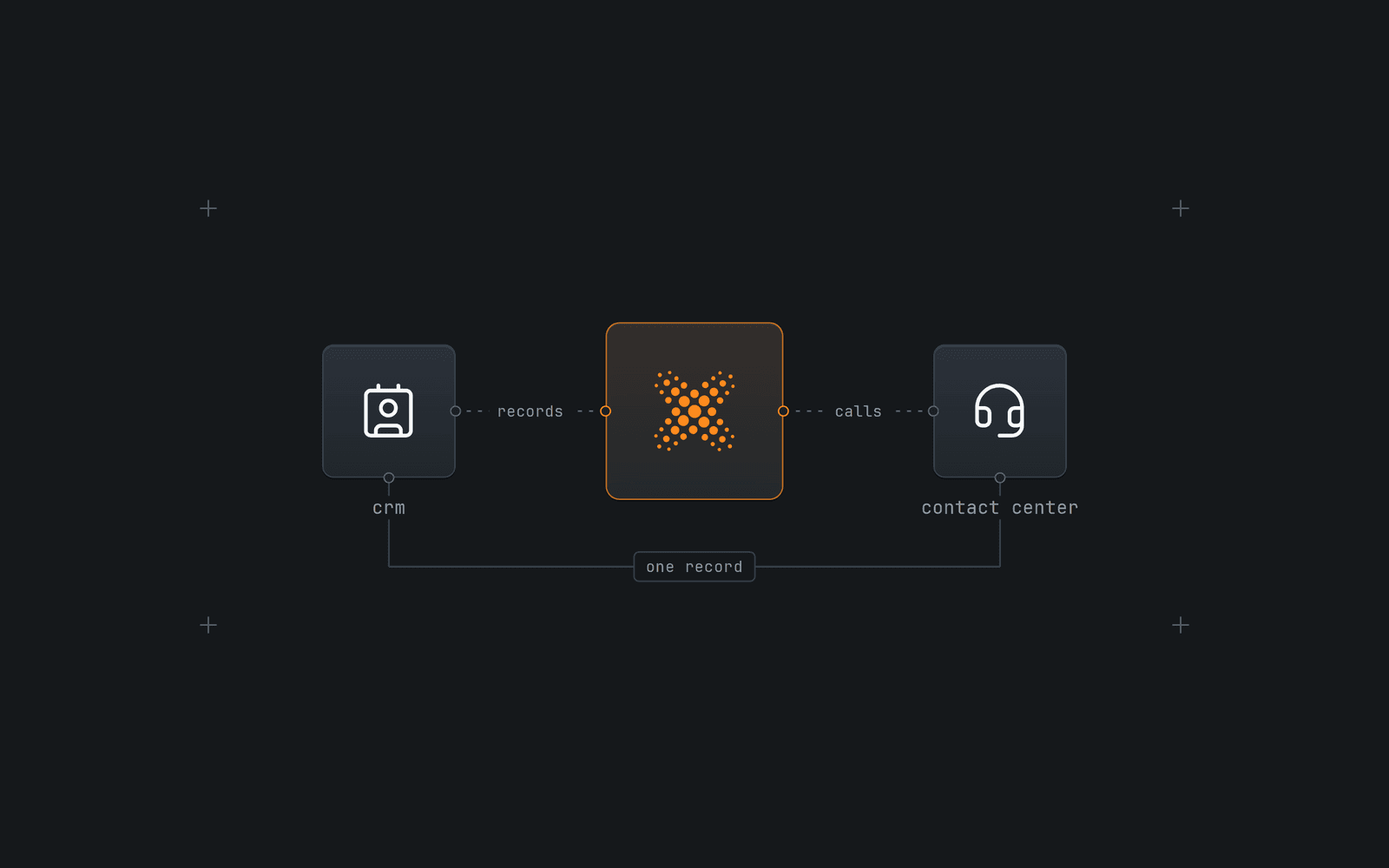
If you lead a contact center or a customer-facing operation, you've lived this: your CRM knows the customer, your phone system knows the call, your ticketing tool knows the issue, and your reporting warehouse knows the numbers, and none of them agree on what happened yesterday. You've hired integrations engineers to duct-tape them together. You've bought a CDP. You've paid for a "360-degree view" at least twice. And every quarter, someone presents a slide arguing that this quarter will be different. It won't be. Not with that architecture. The problem isn't which vendor you picked for each layer. It's that you picked vendors for each layer at all. And with AI now sitting on top of the whole mess, the seams that were merely expensive before are now operationally dangerous.
It isn't a tooling problem
The contact center software market is crowded because every category looks adjacent to every other category. Telephony vendors added CRM. CRM vendors added voice. Help-desk tools added ticketing. Workforce management tools added QA. Each one, in isolation, is fine. Stacked together, they produce a stack of technically connected systems that functionally behave like strangers.
Most contact center problems that get framed as "we need a better tool" are actually data problems in disguise:
- "Our agents can't see context when they pick up a call" → the voice system and the CRM don't share a customer record.
- "Our reporting is always two days behind" → four systems write to four different stores on four different schedules.
- "Our AI hallucinates customer history" → it's stitching together incompatible data models on the fly.
- "Our QA takes a week" → recordings live in one tool, dispositions in another, transcripts in a third.
You can buy more tools to solve those symptoms. Or you can solve the architecture.
Three stages of CRM maturity
Contact center operations tend to evolve through three distinct stages. The jump from stage two to stage three is the one almost nobody talks about, and it's where most teams get stuck for years.
Departmental
Each team runs its own tool. Sales has one CRM. Support has a help desk. The voice team runs the dialer. Data is shared by spreadsheet, Slack, and vibes. Fast to start, impossible to scale.
Integrated
Best-of-breed tools wired together with APIs, middleware, and iPaaS. Looks unified on a diagram. In practice, every release from any vendor threatens a breakage, and the customer record is a join, not a table.
Unified
One platform for voice, CRM, workflows, and reporting. One customer record. One permissions model. AI has something real to reason over. Releases ship together because they live together.
Integrated is what fragmented systems call themselves when they want to get past procurement.
What fragmentation actually costs
The bill for a fragmented stack isn't a single line item, which is precisely why it's so hard to kill. It shows up across four categories: Integration and maintenance: Custom integrations rot. Every vendor ships multiple releases per quarter; every release is a chance for a field mapping to silently stop syncing. Repeat contacts: Repeat calls are the single most expensive way to serve a customer. When an AI agent can't hand off to a human with full context, the customer calls back. Agent ramp and cognitive load: New reps learn four logins, four UIs, and four places where "customer status" lives. Experienced reps spend 20–30% of their day alt-tabbing between systems. Reputational and retention cost: Customers don't care about your architecture. They notice when their bank flags them for fraud in the same foreign country they were traveling to for twenty years.
Why AI makes fragmentation unworkable
Fragmented stacks were tolerable for a long time because the intelligence sat in humans: four reps compensated for the missing data. They remembered yesterday's call. They knew which system to trust when they said. They quickly cleaned up behind the architecture every day. AI cannot do that. AI does exactly what its data tells it to do. If your customer record is actually four records stitched together at query time, AI agents will cite the wrong information, contradict themselves within a single conversation, and confidently promise things that aren't true. Data inaccuracy is the single most common reason AI service projects fail, and siloed systems guarantee inaccurate data. That means the calculus has flipped. Unification used to be an efficiency project. Now it's a prerequisite for everything on your 2026 roadmap that has "AI" in it.
What "unified" actually means
"Unified" gets started into every product category eventually, so it's worth being precise. A unified CRM + contact center has four non-negotiable properties:
- One customer record: Not a CDP sitting in front of three systems. Not a federated query. One table. Every channel, workflow, and agent reads from the same source of truth.
- One set of workflows: The automation that moves a lead through the funnel is the same automation that escalates a support ticket, because they're triggered by the same contact record.
- One permissions and audit model: Compliance controls don't live in four different places with four different inheritance rules. The audit trail is one.
- One reporting layer: Operations leaders don't reconcile numbers across four dashboards. Metrics derive from the same events your workflows are triggered by.
If any of those four are true in stage two, you're in stage two, no matter what the procurement slide says.
The benefits, honestly
Vendor blog posts love to claim ten benefits for everything. Most of them are the same benefit in different words. The honest list, shortened and ordered by how much they actually matter:
AI that works on your data
The headline benefit in 2026. AI voice agents, copilots, next-best-action. They only deliver on their demo when the underlying record is coherent. Unified platforms ship that by default.
Real first-call resolution
When voice, CRM, and workflows are one record, your agents, human or AI, answer with context the first time. FCR isn't a metric you chase higher. It's an architecture property.
Operational speed
New campaigns, new queues, new dispositions, new compliance rules. All of them ship faster when they ship once. Teams on unified platforms don't do integration work to launch a pilot; they produce work.
Compliance that's designed in, not added
One consent record. One DNC suppression list. One audit trail. For regulated work (debt relief, consumer lending, insurance), this is worth more than every other benefit is combined; the first time a regulator asks for evidence; build something you can actually prove.
Lower total cost
Real lower cost, not the kind that shows up as a one-time savings on a procurement desk and disappears into integration fees. Fewer vendors. Fewer maintenance engineers. Lower reports to reconcile.
How to get there without a rip-and-replace
Nobody replaces their entire stack in a quarter, and any vendor who tells you otherwise. Watch for that in your vendors' own roadmap language. A working pattern: 1. Find your highest-friction seam. Usually it's voice + CRM, because that's where customer context hurts the most. Start there. Build your first handoff flow and measure contact rate, qualification completeness, and callback conversion. Unification used to be an efficiency project. Now it's a prerequisite for everything on your 2026 roadmap. 2. Move one workflow end-to-end. Not a partial migration after all, inbound qualification running entirely on the unified platform. Can move in four to eight weeks. A full stack migration is 12–18 months for most mid-market contact centers, done correctly as a sequence of high-conviction rollouts rather than a single event. 3. Measure the before and after. Compliance exceptions → missed disclosures, DNC violations, consent gaps. Target contact rate, handoff quality, first token latency, all the tell-you-faster-whether-it's-working. 4. Expand adjacency at a time. Outbound campaigns, then ticketing, then reporting. Each step deprecates a piece of the old stack rather than bolting on with the same haphazard integration strategy. The teams that pull this off don't start with a $50 page transformation plan. They start with one ugly seam, measure hard, and use the win to fund the next one.
Key takeaways
- Most teams don't have a tooling problem: they have a data problem. A stack with five best-of-breed tools and no single customer record will always lose to a unified platform.
- There are three maturity stages: departmental, integrated, and unified. Integrated looks unified on a slide deck but behaves like departmental when something breaks.
- AI makes fragmentation unworkable: data inaccuracy is the #1 reason AI service projects fail, and siloed systems guarantee inaccurate data.
- The cost of fragmentation isn't only integration fees: it's repeat calls, missed handoffs, agent ramp time, and churn.
- You don't need a rip-and-replace: unification is a direction, not a weekend project. Start with the highest-friction seam.
FAQ
Isn't 'best of breed' better than a unified platform?
Best of breed is a real strategy with real trade-offs. It tends to win when each category is evolving quickly and your integration capability is strong. But every moment that's true at the same time is rare. When the categories are mature, the integration capability is a tax, not a capability. Unified means there's one record, one workflow engine, one permissions model, one reporting layer. Unified wins in that scenario every time.
How is 'unified' different from 'integrated'?
Integrated means the systems talk. Unified means there's one underlying record. If you were at two in one system and fail in another you're in stage two, no matter what the procurements slide says.
What about teams that already have en tools?
Almost everyone does. The question isn't whether you have fragmentation. It's whether you're adding to it or starting to walk it back.
Where does AI fit?
On top of the unified record. Unification used to be an efficiency project. Now it's a prerequisite for everything on your 2026 roadmap that has 'AI' in it.
How long does implementation take?
A single high-value workflow, inbound qualification running entirely on the unified platform, can move in four to eight weeks. A full stack migration is 12–18 months for most mid-market contact centers, done correctly as a sequence of high-conviction rollouts rather than a single event.
What's the one metric that tells me I'm still fragmented?
Repeat contact rate. If more than a small single-digit percentage of resolved interactions generate a follow-up contact on the same issue, your customer record isn't really unified, no matter what your architecture diagram says.