What automated underwriting actually means (when it's not a black box)
The word "automated underwriting" carries a lot of baggage. In mortgage, it means you lose your human judgment. The lender already knows how to read its consumer banking system. In auto credit, it's still more art than science: every lender learns the trade via a financing company run by a human. The difference is profound, but mostly semantic.
What people are looking at when they say "automated underwriting" is a box. In lending, it means one thing: you feed the system your data, the system tells you "approve," "decline," or "refer for manual review" and the system tells you what to do and why. That's the frame that troubles most lenders: lose the ability to exercise the judgment that exists nowhere else but in their files.
There's a meaningful difference from lending a file to a scoring model and getting back a score. That's meaningful. In that model, you score your application. The automation happens inside the lender's head, not in the system. And then the automation happens inside the lender's head, not in the scoring model. That's a meaningful difference: in the first case, the model is doing the scoring. In the second case, the lender is using the scores to make a decision.
The personal loan underwriting stack
Layer 1: Data ingestion and enrichment
Before any rule can run, the system needs data. In the personal loan segment, that data typically comes from the credit bureaus and a credit report. The loan officer or automated system pulls it in. The data ingestion depends on program requirements and applicant geography. It also includes: personal information, contact info, loan amount, and requested term; credit file, along with disputes; income, employment, and expected obligations; and, in many cases, alternative credit data (time on file, rent payments, utility history, etc.).
Layer 2: Eligibility and program gating
Before evaluating the financial conditions, the engine must apply basic program constraints. Are they ineligible for the reason of age, state of residency, debt-to-income, or other such reason? That typically happens before the first condition is evaluated, and they should remove before the full rule set evaluation. A state program may have several rules that are not applicable if the applicant doesn't meet basic eligibility requirements.
The decision tree in practice (walkthrough)
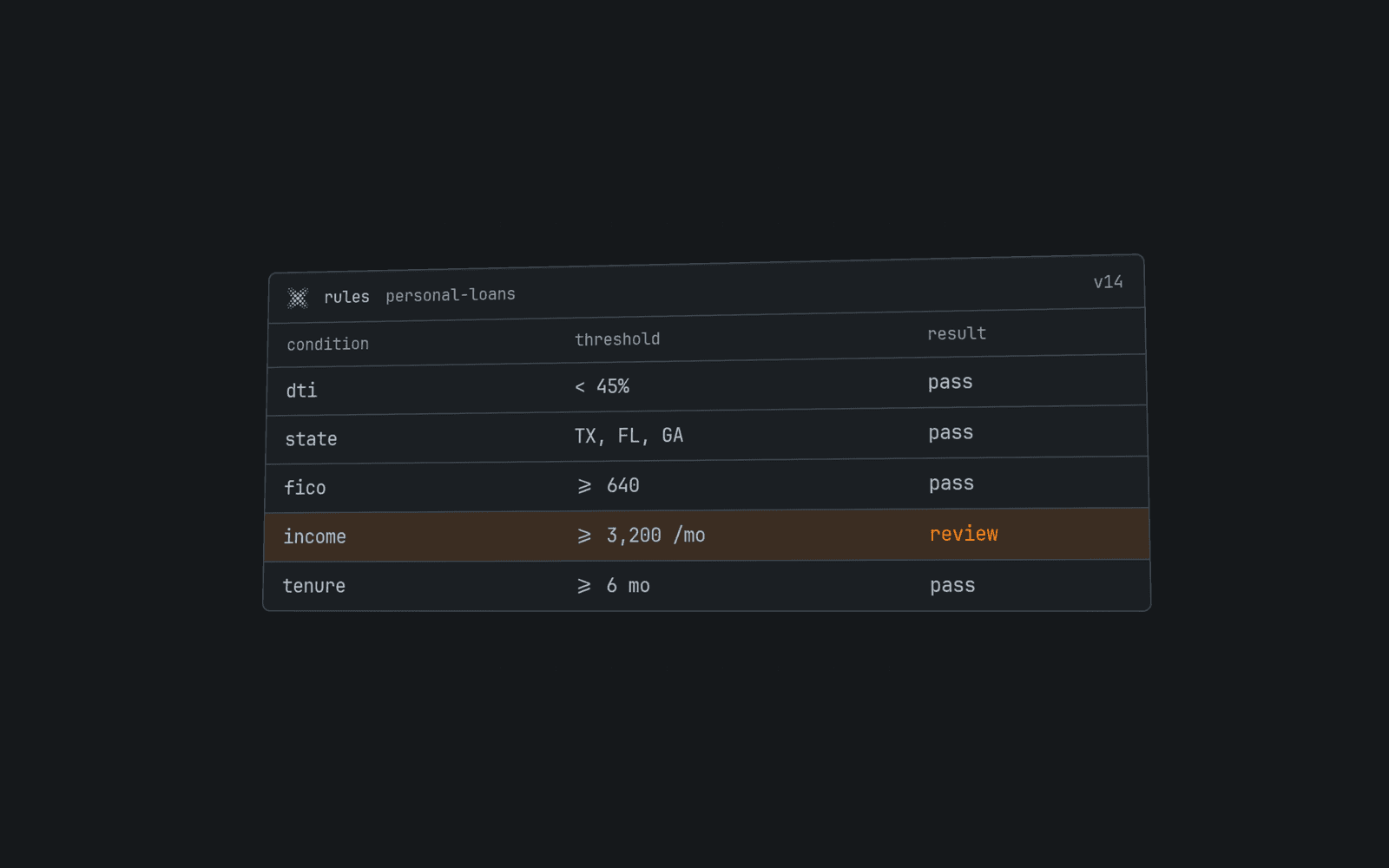
The engine processes a series of conditions, running through a decision ladder. Every condition evaluated; every stage of underwriting is determined based on expected output of all antecedent requirements, each building on the last.
Imagine a rule like the one we've outlined above. The credit pull itself is most critical. The rules may be configured like this rule-of-thumb as per a client's portfolio and current performance, and the model may push to a different performance expectation a quarter later.
What stays human
The automation is the fastest and most consistent evaluator of conditions that an underwriter, be an automated system. Decision sequences are never meant to remain unchanged forever, and they are driven by policy and program and are interpreted as just programs. The model is not necessarily true over time.
Beyond the conditions themselves, beyond calibration and threshold definition, the decision trees themselves need to be tailored. Is a condition that appears legitimate actually a proxy for some sort of hidden status, or is it working as designed? The model always needs human judgment over something like the following:
Compliance guardrails
Automated decisioning in consumer credit doesn't reduce compliance obligations. It actually expands them. Key required conditions include:
ECOA and Reg B adverse action: Applications rejected through Reg B require that applicants receive notice specifying the principal reason or reasons for the denial. When an automated system evaluates an application, a number of discrete variables influence the decision. When a lender denies credit through Reg B, the lender must cite the applicable reason.
FCRA permissible purpose and adverse action: The Fair Credit Reporting Act governs the permissible use of consumer reports. Once a decision is made to deny an applicant on the basis of a report, the lender must furnish the applicant with a disclosure and a copy of the report. In an automated system, the permissible purpose – and adverse action – is hard-wired and logged.
What "in seconds" actually takes (the timing breakdown)
When someone says "loan decision in seconds," the marketing-speak masks the real mechanics. In reality, it's a lot more complex, and the timings can break down as follows:
The rule evaluation step – the actual logic execution – takes 0.1 seconds. The credit pull itself is 1-2 seconds. Data enrichment, again up to a few seconds. Downstream system integration – writing the decision to the loan origination system, notifying the applicant via email, or pushing data to secondary systems – can range from 0.3 to 2.0 seconds, depending on how the system is architected.
FAQ
Can the same platform handle prime, near-prime, and subprime programs?
Yes. The idea is that a rule set built on the same core rule engine will work without modification for program variance – with as you configure it and the rules that are built against it, the system will execute decisioning on every rule. They cover the full spectrum of loan program decisioning. The configurations themselves will be program-specific.
What type programs – are there any that are harder to automate?
Unsecured portfolios that have heavier reliance on subjective decision-making (like the applicant has a strong character reference, or the applicant has a family member who's a customer, etc.) – those are harder to automate. It can be done, but the system may need rules that are manually configured or overridden at the operator level.
How do we handle applicants with thin credit files?
Thin-file applicants or non-prime applicants with slim credit profiles may have fewer data sources to evaluate against. Most lenders' rule sets have fallback approaches. The system can route these to a secondary review queue; or, alternatively, require additional documentation (pay stubs, bank account statements, etc.); or, finally, offer a prime-eligible applicant a co-signer option.
What's the realistic improvement over manual underwriting?
Automated underwriting is 20–30x faster than manual underwriting, but it's not a replacement. Instead, it's a force multiplier for teams. By automating the decisioning that follows a fixed set of policies, the lender frees up its underwriting team to focus on exceptions, edge cases, and applications that trigger a manual review.