Every voice AI demo is built to succeed. The script is clean, the audio is clear, the caller says roughly what's expected, and the agent handles it flawlessly. That is exactly why a good demo tells you almost nothing about whether the thing will hold up once real customers start calling in.
A prompt is not a finished product. It's a first draft that happens to work under ideal conditions. The gap between "worked in the demo" and "still works in week six" is where most voice AI deployments quietly go wrong, and it's the part nobody budgets time for.
The gap between demo and week six
Once a voice agent goes live, three things start happening that never show up in a demo. Real callers speak with accents, background noise, and half-finished sentences. Call volume introduces edge cases nobody scripted for. And the system starts drifting: a prompt tweak for one problem quietly changes behavior somewhere else. None of that is a failure of the initial build. It's just what production does to anything that wasn't tested against production.
The uncomfortable part is that none of this looks like a failure from the outside. Calls still get answered. Transcripts still read fine. Dashboards still show green. The business owner checking in on the numbers has no reason to suspect anything's wrong, because the thing that would tell them is not being measured.
Where quality actually breaks, and why you don't see it
If you, or your team, grade a voice AI the way most people grade it (by reading transcripts and asking "does this sound right") you're checking the one thing that's least likely to catch a real problem. A transcript is a report of what the system believes happened. It is not proof of what actually happened. Four gaps show up over and over once you go looking for them.
- It misheard the customer. Speech recognition makes mistakes more often than most people assume, especially over phone lines with background noise. If a caller says "transfer fifty dollars" and the system hears "fifteen," the transcript still reads as a clean, confident conversation. Nothing about it looks wrong until someone checks the account.
- It took too long to answer. A four-second pause and a near-instant response look identical on a transcript. Timing is invisible in text, but it is the single biggest thing that makes an automated call feel broken to the person on the other end.
- It said the job was done. It wasn't. An agent can confirm a booking, a payment, or a callback in conversation while the system behind it fails silently. The transcript shows what was promised, not what was verified. Checking the promise is not the same as checking the outcome.
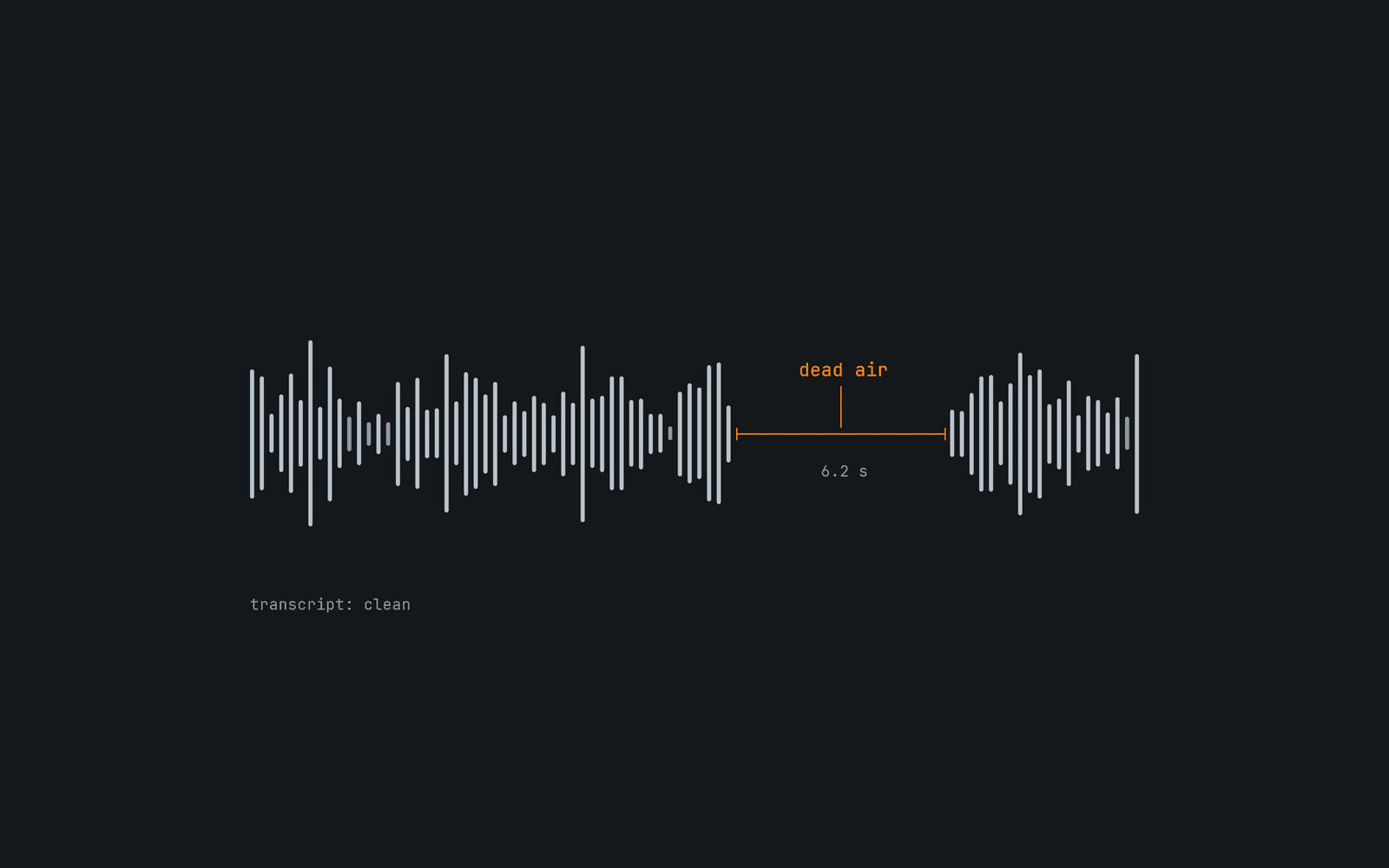
- The customer just hung up. Some of the worst failures leave no transcript at all: a caller who gives up during a long hold, an early greeting that never lands, a menu that loops. If nothing was said, nothing shows up in whatever is reading the conversations. The silence itself is the data point, and it's the one most evaluation setups never look at.
None of these are edge cases. They are the ordinary way a phone call goes wrong, and every one of them can sit underneath a transcript that reads as a perfect conversation.
Why "it read fine" is not the same as "it worked"
Automated tools that grade conversations, and increasingly, other AI systems used to grade conversations, are good at one thing: telling you whether a transcript sounds coherent. That is a real skill and it has real uses. It is fast at flagging conversations that clearly went off the rails, and it is useful for checking whether an agent stayed on script and said the things compliance requires it to say.
What it cannot do is tell you whether the call actually accomplished anything. A transcript that reads beautifully and a transcript from a call that quietly failed the customer can be indistinguishable, because both are graded on the same thing: does this look like a good conversation. Voice quality and text quality are not the same measurement, and treating them as interchangeable is how a business ends up with a dashboard full of good scores and a customer who never got their problem solved.
The pattern worth watching for: high scores on conversation quality and a rising number of customer complaints, at the same time. That combination doesn't mean the scoring is broken. It means the scoring is measuring the wrong thing.
What actually has to happen after launch
Running a real contact center alongside building the technology behind one makes this concrete rather than theoretical. The calls that cause problems are never the ones where the agent clearly failed. Those get caught immediately. The ones that cost money are the ones that looked fine everywhere except where it mattered: the booking that was confirmed in conversation and never made it into the calendar, the payment that was acknowledged and never posted. You don't find those by reading more transcripts. You find them by checking the system the call was supposed to affect.
- Check outcomes, not just conversations. If the call was supposed to book, charge, or update something, confirm the downstream system actually changed. That's the only way to know a "successful" call was actually successful.
- Sample the audio, not only the transcript. Timing, tone, and the moments a caller talks over the system don't survive being turned into text.
- Track the calls that never became a transcript. Abandonment, silence, and early hang-ups are data. If nothing is watching for them, they disappear from the record entirely.
- Re-check regularly, not once. A voice AI that was accurate in month one can drift after a prompt change, a new call type, or simply more volume finding more edge cases. Evaluation is a cadence, not a launch checklist.
Treat the prompt as version one
None of this is an argument against voice AI. It's an argument against treating the prompt as the finished product. The prompt is what gets a system into production. What keeps it working is the ongoing job of watching what it actually does once real customers are on the line, not just what it says it did.
The business owners who get burned by this aren't the ones who chose the wrong voice AI. They're the ones who assumed that because the demo worked and the transcripts looked clean, the job was finished. It isn't. It never really is.
Key takeaways
- The demo proves nothing about week six: real callers, real noise, and real volume expose failure modes a clean demo never triggers.
- Transcripts hide the failures that matter most: mishearing, latency, and silent task failures can all sit underneath a conversation that reads perfectly.
- A good conversation score is not a good outcome: grading whether a call sounds right is not the same as confirming it did what it promised.
- Silence is data too: hang-ups and abandoned calls disappear from most evaluation setups entirely, and they're often the worst failures.
- Evaluation is a cadence, not a launch step: a voice AI that worked in month one can drift, and the only way to catch it is to keep checking.
FAQ
If the transcripts all look clean, isn't that a good sign?
It's a good sign the conversation sounded coherent. It's not proof the call accomplished what it was supposed to. Task completion, timing, and outcomes have to be checked separately, usually by looking at the systems the call was meant to affect rather than the words that were said.
How often should a voice AI actually get reviewed after launch?
Ongoing, not once. A useful minimum is a regular sampling cadence plus a check any time the prompt changes, call volume shifts meaningfully, or a new type of call gets routed to it. Treat evaluation like a recurring operational task, not a one-time signoff before launch.
Can't an automated grading tool just handle this?
It can handle part of it, mainly flagging conversations that clearly went wrong and checking whether required language was said. It can't verify outcomes in downstream systems, measure timing, or see the calls that never generated a transcript at all. Those need separate checks.