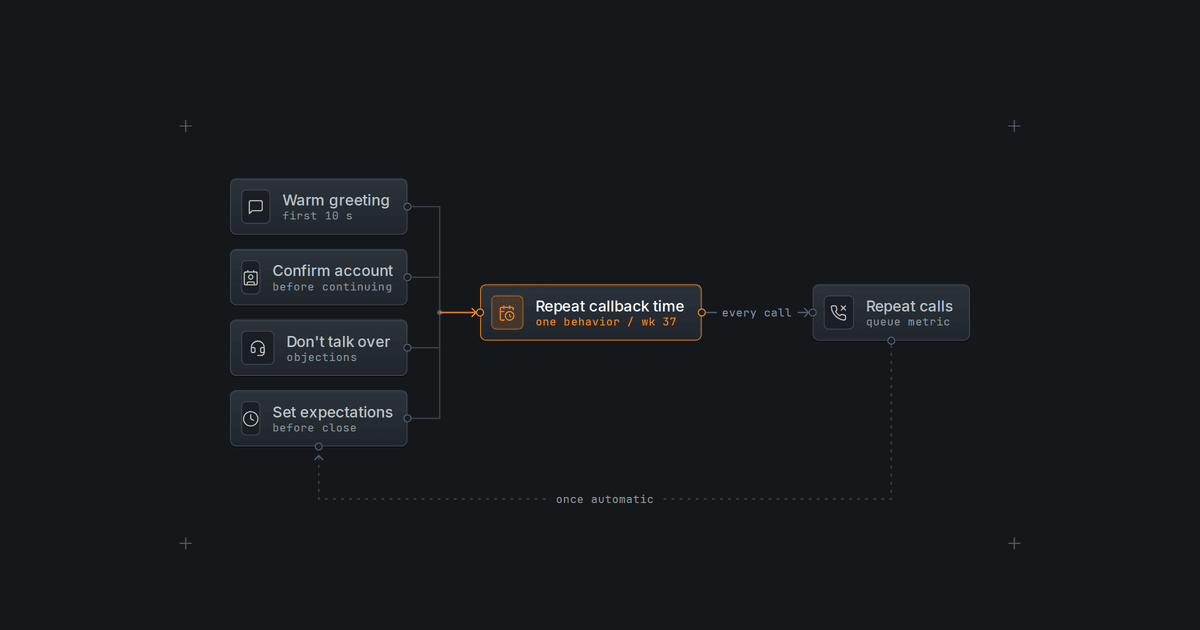
A supervisor at Prosperar used to sit down with an agent once a week, pull three calls, and walk through everything that could have gone better. Greeting was flat. Missed a chance to confirm the account. Talked over the customer twice. Closed without setting expectations for the callback. Four notes, sometimes six. The agent nodded, wrote nothing down, and the next week looked about the same.
The comprehensive review doesn't change behavior
This is the standard shape of call center coaching: pull a sample, score it against a rubric, hand back a list. It feels thorough, which is exactly the problem. A list of six things to fix is not something an agent can act on during their next call. It's something they file away and forget by the third call of the day.
- Warm up the tone in the first ten seconds
- Confirm account details before continuing
- Don't talk over the customer during objections
- Set expectations before ending the call
None of those notes are wrong. But an agent taking eighty calls a day cannot hold four unrelated corrections in their head past call two, let alone call sixty. Something gives, and it's always the coaching, not the call volume.
Pick one behavior, then coach every call against it
The change that actually moved agents at Prosperar was cutting the list down to one item, tied to a number the team already tracked, and checking that one thing on every call the agent took that week, not just the calls a supervisor happened to sample.
One agent on the outbound queue had a callback problem: she was ending calls without repeating the scheduled time back to the customer, and it was showing up as part of the queue's repeat-call rate. Instead of a general note about closing calls better, the coaching for that week was narrow: repeat the callback time, every call, no exceptions. Her supervisor spot-checked calls daily instead of weekly, only for that one behavior. By the end of the week it was automatic, and her share of the queue's repeat calls dropped with it.
One behavior per agent, checked on every call for a week, beats six behaviors reviewed once and never checked again.
Why the narrow version holds and the broad one doesn't
A single, observable behavior is something a supervisor can verify without listening to a full call end to end, which is the only way a daily spot-check stays realistic instead of aspirational. It's also something the agent can check mid-call, because it's one thing, not a mental list. Six-item feedback fails for the same reason six-item personal goals fail: the cost of tracking the list is higher than the benefit of any single item on it.
The behavior only gets rotated out once it survives a normal, busy day, not once the supervisor feels good after one clean call. Move to the next item too early and the list quietly grows back to six, just spread out over a month instead of a single sheet.
Key takeaways
- One behavior beats six: an agent can hold one specific, observable change in their head through a shift. A list of six gets filed and forgotten by the third call.
- Tie it to a number you already track: pick the behavior because it shows up in a metric, not because it sounded wrong on one sampled call.
- Coach every call that week, not just the sampled one: the fix has to survive a normal, busy day, not just the call a supervisor happened to listen to.
- Move on only once it is automatic: rotating to the next behavior before the first one sticks just rebuilds the six-item list, spread out over a month instead of a sheet.